
File previews
Previews help inspect content. Upload support, preview support, and output conversion are separate capabilities. Confirm the original file exists before diagnosing display problems.
Open an image from Gallery
- Find an image in Gallery.
- Click Open / preview on its card.
- Scroll to zoom and drag to pan, or use + / − and Reset.
- Navigate with left / right arrows; press Esc or Close to exit.
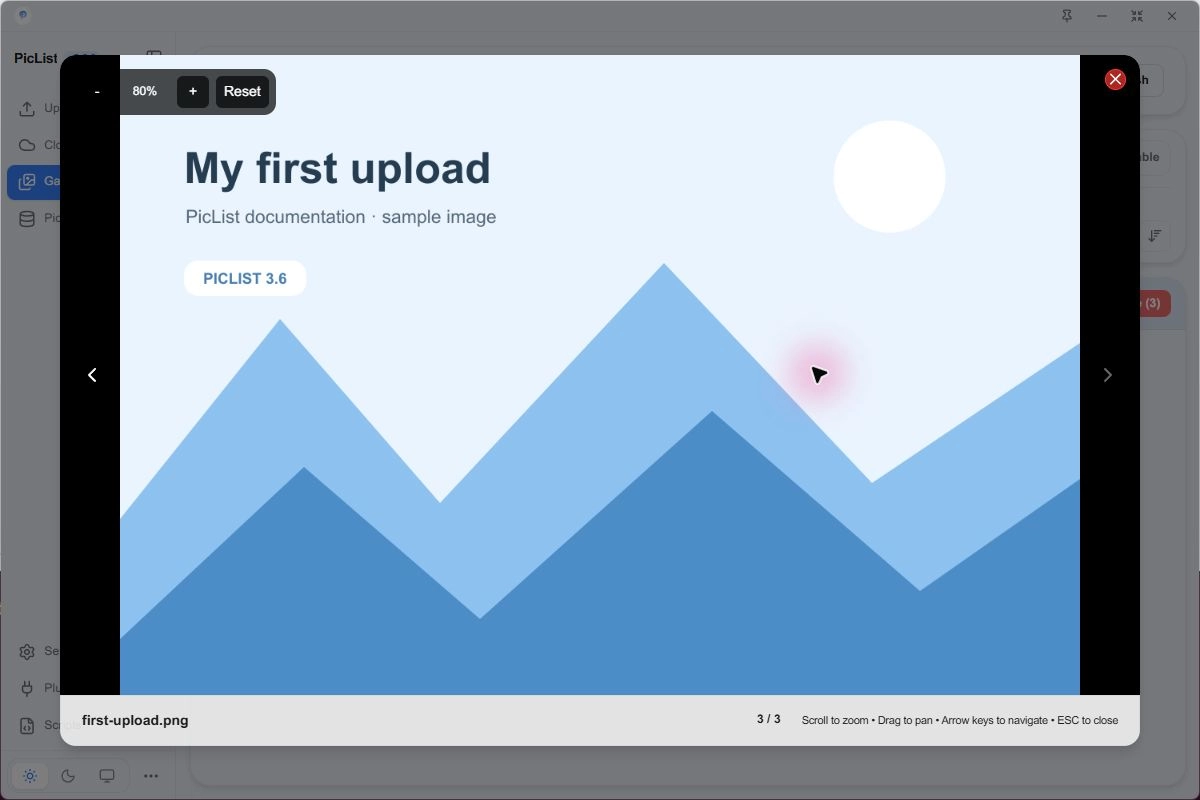
Common images display directly. JXL can use generated PNG previews; 3.6 improves SVG gallery previews. Preview generation does not change the original format.
Cloud management has corresponding preview actions. Large images, private access, and hotlink restrictions can affect loading. Public thumbnail suffixes change management preview requests while copied original links remain unchanged.
Text, code, audio, and video
Supported management previews display text and code. Media playback depends on platform codecs, remote responses, and range requests. A filename extension does not prove the content matches that format.
Download unsupported content and open it with a local tool. Saving an HTML login response with a .png extension will not make it an image.
Preview URLs and published URLs
| Address | Who can access it | Suitable for articles? |
|---|---|---|
| Disk path | This computer | Local references only |
| localhost / 127.0.0.1 cache URL | The computer running PicList | No |
| Public HTTPS image URL | Readers allowed by the service | After verifying |
| Temporary signed URL | Link holders while the signature is valid | Expires |
| Login-required address | Authorized users | Public readers may not have access |
Local, WebDAV, and SFTP can use the internal 127.0.0.1:36699 preview cache. It supplies in-app previews rather than a public website. 3.6 removes the old general-purpose file web server.
After a successful preview, copy URL from Gallery and test it in a browser without a storage service login.
When a preview fails
- Confirm the original file in the directory, bucket, or repository.
- Check whether its URL is local, signed, or login-required.
- Inspect HTTP status and response content in a browser. A 404 commonly points to a path issue; a 403 can indicate access or signature problems.
- Compare the original address without thumbnail suffixes, hotlink restrictions, or extra headers.
- Check actual content, extension, and platform codec support.
- Cached previews need PicList running and readable cache files; inspect the app logs.
When the file exists but the mapping is wrong, fix the address rather than uploading again. See Troubleshooting.